Thursday, March 22, 2012

The Art of Speculation Series 3 - Know when to use your Margin Account


To a lot of people, just a mention about derivatives and margin accounts will send shiver down their spine. This is because one way or another, most of us who are involved in financial markets have been burned by one of the above investment vehicles. Derivatives such as options and futures are actually pretty safe, if not how can the authorities and regulators approve such investment vehicles.

Derivatives are safe


Options and futures are designed for the purpose of hedging. For example currency options are for Multinational Corporations to manage their foreign exchange exposure in their global operations.

Equity options are for people to hedge their portfolio against any undesirable movements in the equities markets. If you are long on ABC shares and if you believe the underlying market conditions will soften. What you can do to protect your downside? One way is to buy a put option on ABC so any downside movement of ABC stock will be hedged.

Interest rate Options are for large institutional investors to protect their large bond positions and also to speculate on changes in the interest rates. A large institutional investor can protect its bonds position against any drop in the interest rate by buying an interest rate put option. Since the price of bond varies inversely with the interest rate, any drop in the interest rate will result in an increase in the bond price. However, by buying a put option on the interest the investor not only enjoy the upward movement in the bond price but at the same time also protects the drop in the interest rates through its put options.

Misuse of Derivatives


The problem with these investment instruments, are that some people instead of using these tool as hedging used it as for speculative purposes. That is where the problem arises. Some people buy put equity options even though they are without any physical shares to deliver when the market go against them. This is what we called a naked short and it can be serious problem because there is no limit to your losses.

Good and Bad of Margin Accounts


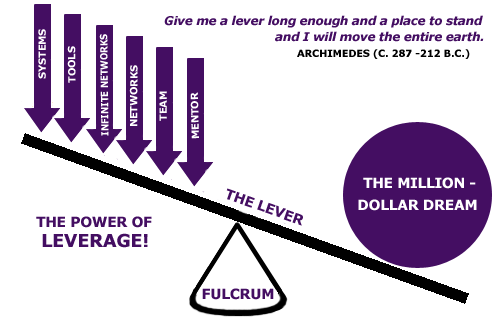
Anyway coming back to margin accounts. It is actually a tool to ‘leverage’ your bets in the stock markets. It is a tool that enables investors using a small amount of money to control a larger piece of an asset. The number of times of leverage an investor will be entirely left to the lenders. It ranges from 100% for an individual investor and up to 2000% for hedge funds and institutional investors.   

However, margin accounts works two ways, leverage correctly will increase your profit tremendously but leverage wrongly it will wipe you out.  

For an illustration, an investor started off with a $50,000 account and he doubles up his account by using margin to $100,000.  If the market is heading downwards, a 10% decline in his portfolio ($10,000) will result in a 20% loss on his original amount ($10,000/$50,000 x100). However, if you are trading in a bear market, it may last many months and eventually it might cause your portfolio to drop by more than 55%. Hence a drop of 55% will translate to a $55,000 loss. This will wipe out his original capital of $50,000 plus an additional of $5000 owing to the broking firm.

Similarly, if his portfolio goes up by 50%, this will mean that his portfolio will now worth $150,000. The profit of $50,000 will translate to a 100% gain on his original capital. So as you can see, margin accounts if used correctly will enhance an investor’s return tremendously.  

It can be seen during the last crash in 2008, where some global indexes drop by more than 70% and needless to say those who are on margin got wipe out. Most investors blamed their losses due to margin accounts. However it is also be noted that there are times where margin accounts are the most useful tool to make money. Thousands of individuals and highly successful investors such as institutional and hedge funds make use of the margin accounts to their fullest advantage.

Time to use margin


The problem is when is the right time to use Margin Account for trading?

The answer is during period of gradually rising market or during the infancy of a bull run. When markets are rising gradually, profits will also rising gradually and losses will be the least of your concern. Individual stocks that are quietly rising from their period of hibernation and beginning to rise on increased volume are most suitable for margin trading. With the increase of capital through the utilization of margin account, an investor can truly increase his profits many fold.

However margin accounts cannot be use all the time for trading. During bear markets, margin accounts had to be sent to the ‘freezer’. Another period where margin account should not be used is during the blow-off stage of a bull run. When used during these periods, I can guarantee that you will be sent to the gutters soon.

Wednesday, March 21, 2012

The Art of Speculation Series 2 - Differentiate between Investment and Entertainment


One of the main reasons why most market participants lost money in the financial markets is that they can’t differentiate between Investment and Entertainment. This is because financial markets can provide you with thrill, excitement, suspense, entertainment, sorrow, hope, heart attack, anxiety and fun at the same time. Due to the advancement of technology, you don’t need to leave home to be ‘entertained’ because all you need is a computer and an internet connection and you are in business. You can play it anytime of the day because there are more than 140 stock exchanges and 50 futures exchange for you to choose from.

It is unfortunate that many of the investors cannot draw a line between them. To them ‘Screen Staring’ is a must during the trading hours.  In actual fact the more you stare at the screen the more money you will lose because you tend to get emotionally involved. Once you can’t stop screen staring, then you need help because you have already cultivated what we called a ‘gambling addiction’.

Unfortunately such an attitude will not help you make consistent gains in the market because there will be many days of losing and winning during a month. At best an erratic performance.  Stock exchanges love speculators because they not only add liquidity to the market but also narrow the spreads and hence lower the cost of transactions. Besides, there are a whole lot of people that are dependent on this industry such as broking firms, stock brokers, marketing people, market analysts, fund managers, government bodies, regulators such as the Exchange and the SEC and so on. In other words it is an industry by itself.

Making money from financial markets is not an easy task because you will be competing with the best minds in the world. You are not only competing with farmers (like me), mechanics, bus drivers, housewives, fish mongers but also rocket scientist, lawyers, doctors, fund managers, market analyst, engineers and et al.

A lot of speculators have mistaken themselves as investors because they don’t understand the differences between speculation and investment.  In normal circumstances, the return on your long term investments will always be better than your speculations in the short term. This is because the costs of transaction, taxes, interest rates and others are very prohibitive.


The following tables show the result of three different scenarios on the effect of transactions costs, taxes, inflation rate and etc on your portfolio.


1) No transaction costs and inflation rate of 5% p.a.

Assumptions:

  1. Initial outlay - $100,000
  2. Annual returns -10%
  3. Transaction costs, taxes, interest rates and other costs - 0% per annum
  4. All returns are reinvested and no addition of extra funds
  5. Inflation rate is 5% p.a.

Table 1. Returns on 5% (10% - 5%)


Duration in YearsReturns in $
10
163,000
20
263,000
30
432,000
40
704,000
50
1,147,000


2) Transaction costs of 3% and inflation rate of 5% p.a.

Assumptions:

  1. Initial outlay - $100,000
  2. Annual returns -10%
  3. Transaction costs, taxes, interest rates and other costs - 3% per annum
  4. All returns are reinvested and no addition of extra funds
  5. Inflation rate is 5% p.a.

Table 2. Returns on 2% (10% - 5% - 3%)


Duration in YearsReturns in $
10
122,000
20
149,000
30
181,000
40
221,000
50
269,000


So as you can see from the above, both accounts started off with an initial outlay of $100,000 but the difference of just the 3% costs of transaction will indeed result in a substantial difference in the final outcome. You see the difference is $878,000 or it can be interpreted as savings of more than 300% of your money if you trade less.

The difference of $878,000 is what we called the ‘Entertainment Fees’ for getting our dose of ‘adrenalin fix’ when we go in and out of the market. So what will be the net result if we can reduce our transaction costs to 1 % instead of the 3% by trading less? The following table will illustrate the difference.

3) Transaction costs of 1% and inflation rate of 5% p.a.

Assumptions:
  1. Initial outlay - $100,000
  2. Annual returns -10%
  3. Transaction costs, taxes, interest rates and other costs - 1% per annum
  4. All returns are reinvested and no addition of extra funds
  5. Inflation rate is 5% p.a.

Table 3. Returns on 4% (10% - 5% - 1%)


Duration in YearsReturns in $
10
148,024
20
219,112
30
324,339
40
480,102
50
710,668


Again as you can see by reducing your transaction costs by another 2%, it will save you a substantial amount of money. The total savings is $710,668 - $269,000 = $441,668 which is quite substantial. Anyway the above figures can be obtained by using the Future Value formula.


FV = PV(1+k)n

Terminology explained.

FV = Future Value
PV = Present Value or original amount (in this case $100,000)
k = annual rate of interest rate
n = number of period (years in the future)


Our conclusion is, in order to be successful in investing in the financial markets, you need to draw a line between investment and entertainment. If you need to be entertained, I suggest you need to look elsewhere like drinking in a pub, sing your heart out in a karaoke, bungee jumping, rock climbing, play golf and other games. That’s what I do.

Sunday, March 18, 2012

The Art of Speculation Series 1 - Know when to Sell


As they said, speculation is as ‘old as the hills’. However, there is a difference between speculation and investment. Speculation is an adventure ‘without calculation’ whereas investment is an adventure ‘with calculation’.  

A good example of speculation will be a speculative trade in a mining company. Say if ABC mining company announces that it had started prospecting gold in an area where it believed to hold a massive reserve. Without any further information released by the company, people who buy shares in the company upon hearing the news in hope that it will strike gold are called speculators. This is because the chances of it striking gold is very slim and such an adventure is purely betting because it involves high risk.  

As for an investor, his approach to investing is different. He will look for a company with stable earnings, dividend payout and also a good business model. He would probably be looking for a large multinational with a good track record and hence provides a low risk and steady return.   

The problem with both investors and speculators are they do not know when to sell because buying is easier than selling. Knowing what to buy and not knowing when to sell is akin to a manager who knows how to sell but don’t know how to collect. There are basically two problems arising when you don’t know when to sell.

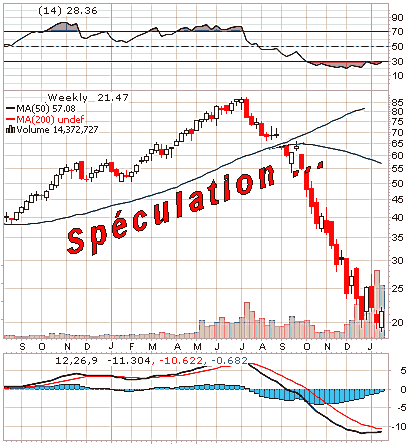
One, trading profits are still what they call ‘paper profits’ when it is not liquidated. It will be an extremely bitter experience to watch your stock to go up in a straight line and then see it drop dramatically back to your purchase price and worst still below it. I am sure most of us have experience this in our stock market trading. How we wish that we had liquidated the stock before its price head south.

Two, we tend to be greedy when the stock price is going up steadily. Even though it had surpassed our price target, we will not sell because we will always hope it will go higher. However, the inevitable will happen when the stock price corrects, bringing it back to the ground and hence the profit disappears. Even though investors have set a predetermined price to sell, they will ignore it because they doesn’t want to sacrifice any part of their future profits.

So, how do we tackle such a situation? Professionals use a method known as ‘Stop Loss Order’. How does this work?  Say, if an investor buys 10 lots of ABC shares at $1 each, what he will do is put a stop loss at $0.95. If the share price goes down to $0.95 or below then the order will be executed. However if the share price goes up to $1.10 then he will adjust his stop loss price to $1.05. If it keep going up then he will need to re-adjust his stop loss upwards. So whenever the stock price corrects to the stop loss level, the stop loss will be executed and thus the profits will be protected.

Another way to protect your profits and loss is to follow an old adage from Wall Street and that is ‘sell till you feel comfortable’. Say if you bought 100 lots of ABC shares and if it has been giving you sleepless nights then the remedy will be to sell down the stocks until any movements up or down will not affect you emotionally. Hence, you will not have any more sleepless nights.

When come to investing we will need to differentiate between hope and reality. When market turns against us, we need to either take profits or cut losses. As we have said earlier it is easier to buy than sell and taking profits will not make you broke.

Monday, March 12, 2012

Debunking Myths 2 - Leakages and Negative Compounding don't matter?

Due to the level of competitiveness that investors are facing nowadays, it is important to take a second look at the cost of transaction and losses. Transaction cost may include brokers commission, government taxes, stamping fees and etc. This is because when you are investing, your main motive is to increase the return on your investment. The problem is that while you are winning someone else on the other side is losing. In a way it is very harsh out there, it is like a battleground either you win or they win.

Wealth Creation


Just to illustrate, what a mere $1000 savings from your brokerage commissions and government taxes can do to your personal wealth. We based on the following assumption

  1. $1000 initial investment
  2. 10% per annum
  3. don’t add or withdraw any money
  4. inflation not taken in

Table 1 – the effect of 50 years of compounding on $1000


YearsTotal Return
10 years
$2,590
20 years
$6,730
30 years
$17,450
40 years
$45,260
50 years
$117,390


So, you can see the effect of compounding on wealth creation. Even with small amounts saved by trading less in the markets will make a lot of difference in your wealth creation process. Empirical evidence shows that those who are engaged with hyper trading will almost ‘go home broke’,by the end of the day.

Important to know Negative Compounding


By understanding the effects of both positive and negative compounding improves your chances of success. A lot of investors are only concerned with positive compounding and neglecting the importance of negative compounding that will affect their portfolio.

In the following, we will show 2 different portfolios that will produce different returns even though they both achieve the same compound rate (200%), over a period of 10 years.

In table 2, we have a fixed income portfolio that produce 20% every year until the 10th year. No matter what happens to the economy, this portfolio will generate a 20% return throughout the duration of 10 years.

Table 2 – Fixed return of 20% p/a


YearPercentage %/yearTotal Return based
on $1000 investment
1
20%
$1,200
$1000 x 20%
2
20%
$1,440
$1200 x 20%
3
20%
$1,728
$1440 x 20%
4
20%
$2,074
$1728 x 20%
5
20%
$2,480
$2074 x 20%
6
20%
$2,987
$2480 x 20%
7
20%
$3,584
$2987 x 20%
8
20%
$4,301
$3584 x 20%
9
20%
$5,161
$4301 x 20%
10
20%
$6,193
$5161 x 20%
          Total = 200%
$6,193.00


The above Table shows the return of a portfolio with an initial investment of $1000 and with a yearly return of 20%, ended up with $6193 after 10 years of compounding.


The following Table 3, shows the same portfolio started off with an initial sum of $1000 and also with a duration of 10 years. The only difference is the rate of return, which is rather erratic, which gyrates between 50% and – 10%. You will see that the end result is much different at the end of the 10 years period.

Table 3 – Variable Returns on different years

YearPercentage %/yearTotal Return based
on $1000 investment
1
50%
$1,500
$1000 x  50%
2
-10%
$1,350
$1500 x -10%
3
50%
$2,025
$1350 x  50%
4
-10%
$1,823
$2020 x -10%
5
50%
$2,735
$1827 x  50%
6
-10%
$2,462
$2735 x -10%
7
50%
$3,693
$2462 x  50%
8
-10%
$3,324
$3693 x -10%
9
50%
$4,986
$3324 x  50%
10
-10%
$4,487
$4986 x -10%
          Total = 200%
$4,487.00


As your can see the difference between portfolio A and portfolio B is $6139 - $4487 which is $1706 which is quite sizeable. That is why a lot of people come to the wrong conclusion when both portfolios produce a 200% returns, somehow the monetary return will be the same. But the above tables show a different outcome, where Table 2 gives a better return than Table 3. How can this be?

The answer is, portfolio B have both positive and negative returns. In good years, it is compounding at a rate of 50% while in bad years it is compounding negatively at –10%. A negative rate of compounding will actually slows down the rate of return.

A good example is say a stock is trading at $100, if it experience a 50% drop, then the share price will be $50. In order to recuperate the $50 losses, the investor will need to achieve a 100% return on his $50 stock. This is the disadvantage of negative compounding because it need to work extra hard in order to play catch up with earlier losses. In other words, losses compound too.

This is why you need to use ‘Stop Loss’ orders if your stocks are going down, if not it will be doubly hard for your portfolio to regain its losses. Understanding this will have implications on your portfolio management because how often will you achieve a 100% return on your portfolio. In other words, you will need to learn how to keep your winners and discard your dogs.


On conclusion, understanding the power of negative compounding will help you in your selection of Mutual Funds and Dividend Yield stocks for your retirement portfolio. Especially in the Mutual Funds industry, the benchmark for performance is usually 3 years, 5 years and 10 years period. The problem is, the mutual fund companies only provide us with a lump sum figure as in xx % in say 5 or 10s year period. Normal investors will never know the breakdown of their earnings. They may earn a total of 120% over a 10 year period, but what good is it if it lose 8 and win 2 years? Negative compounding will work its way into the actual monetary gain. The same goes to Dividend yield stocks, as we prefer a stock with a stable dividend payout than another with rather inconsistent dividend payout.